This post may contain affiliate links. If you book or buy through our links, we may earn a small commission at no extra cost to you. Learn more.
Published · Updated
South Korea lets passport holders from over 111 countries enter without a visa. For most Western travelers that’s a non-issue — you already qualify, you already know. But the details matter more than people expect: there’s a new digital form that replaced the paper card in 2026, an electronic authorization system that confuses even experienced Korea travelers, and a few quirks in the rules that are worth knowing before you book.
This covers what you actually need to understand before arriving — not just whether you qualify, but what you’ll need to do beforehand.
Does Your Passport Qualify?
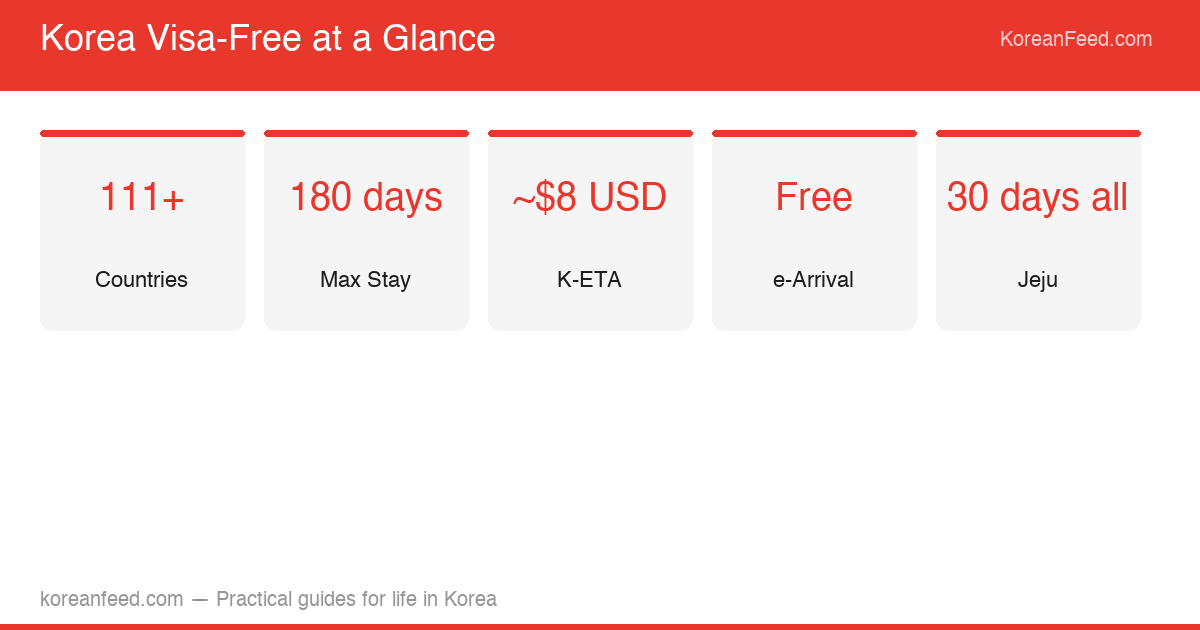
The short answer for most readers: yes. Citizens of the US, Canada, UK, most of the EU, Australia, New Zealand, Japan, Singapore, Hong Kong, Macao, Taiwan, and Israel all have visa-free access to South Korea. The full list runs to about 111 countries and territories, maintained by the Korean Ministry of Foreign Affairs.
Notable exception on the other side: Philippine, Vietnamese, and Indonesian passport holders generally need a visa for Korea. Thailand and Malaysia are visa-free but worth confirming on the MOFA bilateral list before you fly, since Southeast Asian visa-free access varies more than people expect.
How Long Can You Stay?
Most visa-free nationals get 90 days per visit. That covers the US, UK, EU, Australia, New Zealand, Japan, and most others. The exception worth knowing:
Canada gets 180 days — six months, no visa — under a bilateral agreement that’s unique among any country’s access to Korea.
That 180-day allowance isn’t widely publicized. Canadian passport holders planning extended stays in Korea often don’t realize they can enter without a visa for six months at a stretch.
Stay limits apply per entry, not per year. Leaving Korea and re-entering resets the clock, though immigration officers can and do deny entry if it looks like someone is using repeated short visits to effectively live in the country long-term.
K-ETA: Who Needs It, Who Doesn’t
This is where most of the confusion lives. South Korea introduced the K-ETA — Korea Electronic Travel Authorization — in 2021. It’s an online pre-approval required for visa-free travelers, similar to the US ESTA or Australia’s ETA. You apply at k-eta.go.kr, it costs ₩10,000 (around $8 USD), and once approved it’s valid for three years.
However — and this is the part that trips people up — Korea has been running a temporary exemption from K-ETA for 22 specific countries since 2023, extended annually. The current exemption runs through December 31, 2026.
USA · Canada · UK · Australia · New Zealand · Japan · Singapore · Hong Kong · Macao · Taiwan · Austria · Belgium · Denmark · Finland · France · Germany · Italy · Netherlands · Norway · Poland · Spain · Sweden
If your passport is on that list, you can board a flight to Korea with nothing but your passport — no pre-approval, no forms, no fee. If your passport qualifies for visa-free entry but isn’t on the exemption list, you’ll need to complete the K-ETA before flying.
Planning a trip to Korea?
Check our guides on where to go, getting a SIM card, and K-ETA requirements before you fly.
The K-ETA exemption has been extended three consecutive years. It may be extended again for 2027, but that’s not guaranteed — travelers planning trips from late 2026 onward should check for updates, particularly if booking flights that cross the January 1 date.
New in 2026: The e-Arrival Card
Korea eliminated the paper disembarkation card on January 1, 2026. Every foreign visitor now submits a digital e-Arrival Card instead — free of charge, through the Korea Immigration Service portal or their app. It must be completed within 72 hours before arrival (Korea Standard Time).
One practical note: travelers who hold an approved K-ETA don’t need a separate e-Arrival Card — the K-ETA covers that function. So if you’re in the K-ETA-required tier and you’ve already applied, you’re set. If you’re in the exempt-from-K-ETA group, the e-Arrival Card is what you fill out instead.
Jeju Island: Different Rules Entirely
Jeju operates under a separate visa waiver that applies to everyone, including nationalities that normally require a Korean visa. Any passport holder can visit Jeju Island visa-free for up to 30 days — with the condition that you’re entering directly through Jeju International Airport and staying on the island.
This means that Philippine, Vietnamese, or Indonesian travelers who can’t enter mainland Korea without a visa can still visit Jeju without one. The catch is the “staying on Jeju” restriction — if you want to continue to Seoul or anywhere else on the mainland, a visa is required.
If Your Country Isn’t on the Visa-Free List
The Korean government runs an e-Visa portal at visa.go.kr that covers most tourist and short-stay visa categories. The standard C-3 tourist visa typically processes in 7–10 business days and requires a valid passport, application form, photo, proof of accommodation, return ticket, and financial documentation. Korean embassies and consulates handle in-person applications for countries without strong e-Visa infrastructure.
If you’re planning the trip around a specific date, apply with enough buffer. The 7–10 business day estimate is for straightforward applications — peak periods and missing documents can extend that.
Find Hotels in Seoul
Visa confirmed — time to book your stay. Agoda covers the full range from budget guesthouses to design hotels in Hongdae, Myeongdong, and Gangnam.
Official Resources
- K-ETA Application — k-eta.go.kr
- Korea Immigration Service — immigration.go.kr
- Ministry of Foreign Affairs Korea — mofa.go.kr
- Korea e-Visa Portal — visa.go.kr
For getting around once you’re in — airport transfers, subway, intercity trains — the Incheon to Seoul guide and the Seoul Subway guide cover the practical details.
Once your entry is sorted — get the essentials booked
- T-money Card — transit card for Seoul subway and buses
- Korea SIM Card — airport pickup, data from day one
- AREX Express Train — Incheon Airport to Seoul Station
Entry requirements change. This article reflects conditions as of May 2026. Always verify current requirements through the official sources linked above before traveling.
You might also like






Sem Kim has lived and worked in Seoul for over a decade. He writes about the practical side of navigating Korea as a foreigner — immigration, transport, local services, and the parts of daily life that guidebooks tend to skip. His work draws on firsthand experience moving through Korean bureaucracy, neighborhoods, and systems that aren’t always designed with international visitors in mind.